

Powered by ditriptyre



Complete Guide to Winter Tyre Selection: Types, Markings and Practical Tips
As winter approaches, choosing the right winter car tires becomes crucial for ensuring driving safety and ride comfort. This article will help you fully understand the types, core markings, key parameters of winter tyres, as well as common misunderstandings in selection and use.
I. What are "Winter Tyres" and Their Differences from All-Season Tyres
The term "winter tyre" specifically refers to studded winter tires in the professional field, but in daily language, it can also generally refer to non-studded winter-specific tyres. The all-season tyres we often mention correspond to the professional term all season tyre. The core difference between the two lies in the chemical composition of the rubber compound and the tread pattern design. When the ambient temperature is below +7°C, the rubber of winter tyres can still maintain good elasticity, thereby stably maintaining adhesion to the road surface; in contrast, the rubber compound of all season tyres or summer tyres will become "hard" as the temperature drops, and key indicators such as grip and braking performance will drop sharply.
In Russia, according to the technical regulations of the Customs Union, winter performance tires must bear a mandatory marking - the "mountain with snowflake" symbol (3PMSF). All winter tyres that truly meet the standards must have this marking to prove that they have passed the standardized performance tests on snow and ice surfaces. Many car owners have a misunderstanding that the snowflake pattern or "M+S" (Mud + Snow) on the tyre is sufficient to prove its winter applicability. In fact, "M+S" is only a structural characteristic description, indicating that the tyre is suitable for muddy and snowy environments, but it cannot guarantee the core winter performance required by the regulations; the 3PMSF marking is the core basis for judging whether a tyre is a qualified winter car tire.
Based on practical observations, the greatest cognitive confusion occurs precisely with all season tyres. Such tyres usually have M+S markings and are equipped with moderately aggressive tread patterns, but their rubber formula is a compromise that balances performance in different seasons. In severe cold winters with frequent snowfall and icy road surfaces, the performance of all season tyres is significantly inferior to that of special winter tyres, especially the gap is more obvious when driving on ice. In terms of positioning, all season tyres are more suitable for use in areas with mild winters, more rain and little frost.
II. Studded Tyres vs. Non-Studded Tyres ("Friction Tyres" or "Ice Tyres"): How to Choose
This is a core problem faced by most car owners when purchasing winter car tires. The two types of winter tyres each have their own focuses and are suitable for different usage scenarios.
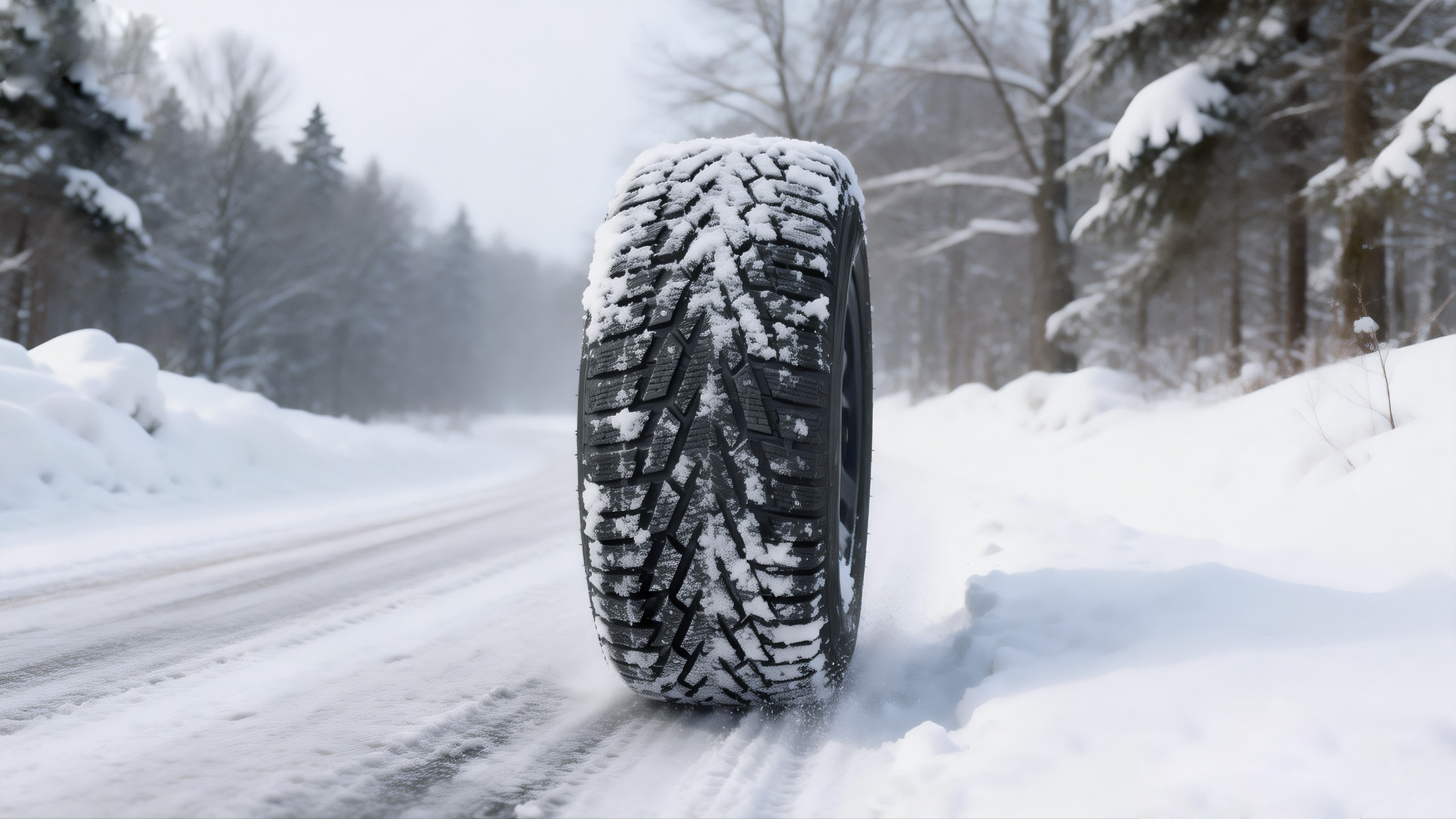
Studded winter tires : The tread is inlaid with metal studs (usually 90-130 in number). These metal studs can directly cut into ice surfaces and compacted snow, so they can provide maximum grip on such road surfaces. Its core advantage scenarios include: icy roads, "slush" sections and compacted snow winter rural roads. However, it should be noted that on clean asphalt roads (especially wet asphalt roads), the grip performance of studded winter tires is poor, the braking distance will be correspondingly prolonged, and the driving noise is louder, and the tyre wear rate is also faster. In addition, because metal studs can damage road surfaces, many countries and regions have restrictions on the use of studded winter tires, and some areas also levy additional taxes and fees.
Non-studded tyres ("friction tyres" or "ice tyres"): As another important type of winter tyre, its core feature is the non-studded design. Grip mainly comes from a special soft rubber formula and a highly developed tread structure (usually asymmetric or directional pattern design), with a large number of sipes (small grooves) distributed on the tread. These sipes will actively "open" when driving on snow and ice surfaces, enhancing the fit with the road surface like a suction cup, thereby improving grip. The core advantages of non-studded winter tyres are: excellent comprehensive performance on dry and wet asphalt roads, lower driving noise, and better fuel economy. Its disadvantage is that on smooth ice or compacted snow surfaces, the grip performance is still inferior to that of studded winter tires.
How to choose? If you mainly drive in the city, the road snow is cleared in a timely manner, and you drive on asphalt roads (even wet or loose snow-covered asphalt roads) most of the time in winter, non-studded winter tyres will be a more balanced and comfortable choice; if your travel route often passes through suburban roads where snow is not cleared in a timely manner, you frequently encounter black ice, or the winter in your area is long and severe cold, then studded winter tires are more worthy of consideration. In addition, for drivers who need to drive frequently on icy water surfaces, studded winter tires are almost an irreplaceable choice.
III. Key Parameters for Selection: Size, Speed Rating and Load Index
In addition to clarifying the type of winter tyre, it is also necessary to ensure that the technical parameters of the tyre fully match the vehicle when purchasing. Among them, the most error-prone misunderstanding is buying winter car tires of non-standard size.
1. Size (e.g., 205/55 R16): The tyre size must fully comply with the recommended value by the vehicle manufacturer in the user manual or the label on the door frame. Installing tyres wider than the standard may deteriorate snow handling and cause "floating" phenomenon; choosing tyres narrower than the standard - although some opinions believe that narrow tyres are easier to "cut through snow" - may have a negative impact on the driving stability and load-carrying capacity of the vehicle.
2. Speed Rating: Expressed by letters (such as T, H, V, etc.). For winter tyres, it is allowed to use tyres with a speed rating lower than the original factory standard (but not lower than Grade Q, corresponding to a maximum speed of 160 km/h), because winter road conditions are complex and driving styles are usually more moderate. For example, if your vehicle uses Grade V (maximum speed 240 km/h) tyres in summer, it is feasible to replace them with Grade T (maximum speed 190 km/h) or Grade H (maximum speed 210 km/h) winter tyres in winter.
3. Load Index: Expressed by numbers, representing the maximum load-carrying capacity of a single tyre. When purchasing winter car tires, you must never choose products with a load index lower than the recommended value by the vehicle manufacturer, otherwise it will seriously affect driving safety.
4. Production Date: Tyres are rubber products and will age naturally even if not used. The production date is usually engraved in an elliptical mark on the side of the tyre, expressed by four digits (the first two digits are the week number, and the last two digits are the year, for example, "2523" means the 25th week of 2023). It is recommended not to buy winter tyres with a production date exceeding 3-4 years. Aging rubber will lead to decreased elasticity, cracks and other problems, which will greatly reduce the safety of use.